
Playable OOH: The Future of Out-of-Home Advertising
Being seen is no longer enough. Here is what changes when an ad stops asking for a glance and gives people something to do, and where that plays out across screens and mobile.
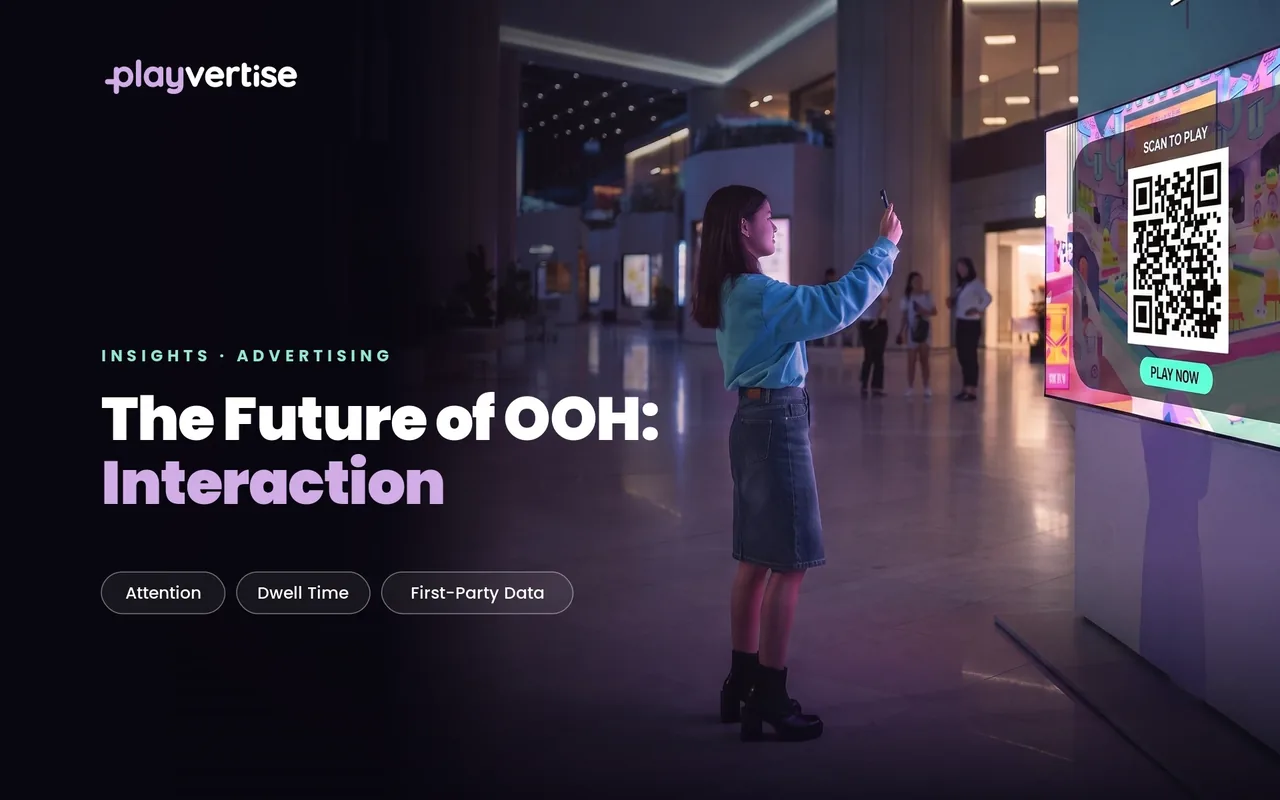
The glance is not the goal
Grabbing attention has never been harder. We scroll on autopilot, and our eyes slide past banners, posters and video pre-rolls before a single message lands. For years the answer was to be louder or more often: more reach, more repetition, a bigger screen. That still buys a glance, but a glance is not a memory. The brands standing out in 2026 are doing something different. Instead of asking people to watch, they hand them something to play.
From watching to doing
A static ad is over in a second, often less. A game is another kind of thing entirely: people lean in, tap, swipe, make decisions, and stay. That move from passive to active is the whole point of playable advertising. The message is not shown to someone, it is something they work through themselves, and what people do tends to outlast what they are simply shown. In one industry study, interactive playable formats drew about 47 percent more attention than classic video ads (IDEA Global, 2025). Not louder, interactive. That is the difference between being seen and being remembered.
The screen becomes the game
The clearest version of this lives on a big screen. Picture an endless runner on a display in a shopping center, at a trade show or in a retail window: someone scans a QR code, their phone becomes the controller, and every swipe makes their character jump, dodge or grab the next prize. The screen reacts to each move as it happens, and a live leaderboard climbs with their name on it, solo or in multiplayer against the people standing next to them. This is the shift that makes it work: the audience is not watching the screen, they are steering it. A passive placement becomes a shared moment with the brand.
Branding is the whole game
Where playable advertising earns its memory is in how far the brand goes. With playvertise, branding is not a logo dropped into the corner of a generic game. It is the whole game: logo, colors, sprites, prizes and the mechanic itself all carry your brand. Whoever plays moves through a world that looks and feels entirely like you, not a template with your name pasted on top. That is what turns a contact into an interaction, and an interaction into something people remember and pass on.
What you can actually measure
The other thing interactive beats static on is proof. Passive advertising leaves you estimating who saw it. A playable activation is measured from the first play. Your dashboard shows plays, how often it was really played rather than merely seen, and the first-party contacts that arise voluntarily when someone opts in, all exportable as a CSV to back up internally. On top of that, whoever plays spends real, focused time with your brand, so seconds turn into minutes of dwell time. A good impression becomes a measurable result.
Takeaway
Playable advertising is not a gimmick bolted onto a campaign. It works because participation earns the attention a glance never will, and because every play is something you can measure. Getting there is simple: in the GameHub you pick a mode, screen or mobile, choose a ready game from the library, and brand it with your logo, colors, prizes and lead fields. From there you go live in a short time: no app, no extra hardware, no code. The build stays yours for the whole license term, so you reuse it across every channel your mode covers, and adapt it to the season whenever you want.
Advertising you play. Curious how your brand would look as a game people actually play? Talk to us at playvertise.io.
Try the idea as a campaign?
We translate the idea from this article into a concrete game setup, tailored to your channel and budget.
Free and non-binding