Where Gamification Is Heading: Inside the Marketing Slice of a Tripling Market
The gamification market is set to triple by 2031, reaching USD 112.32 billion (Mordor Intelligence, 2026). It is a striking figure, but on its own it is the kind of hockey-stick chart every category shows off. The more useful questions are narrower: which part of that market is relevant to brands, why is it growing, and what separates the campaigns that pay back from the ones that quietly do not.
The market is tripling, and two houses agree on the shape
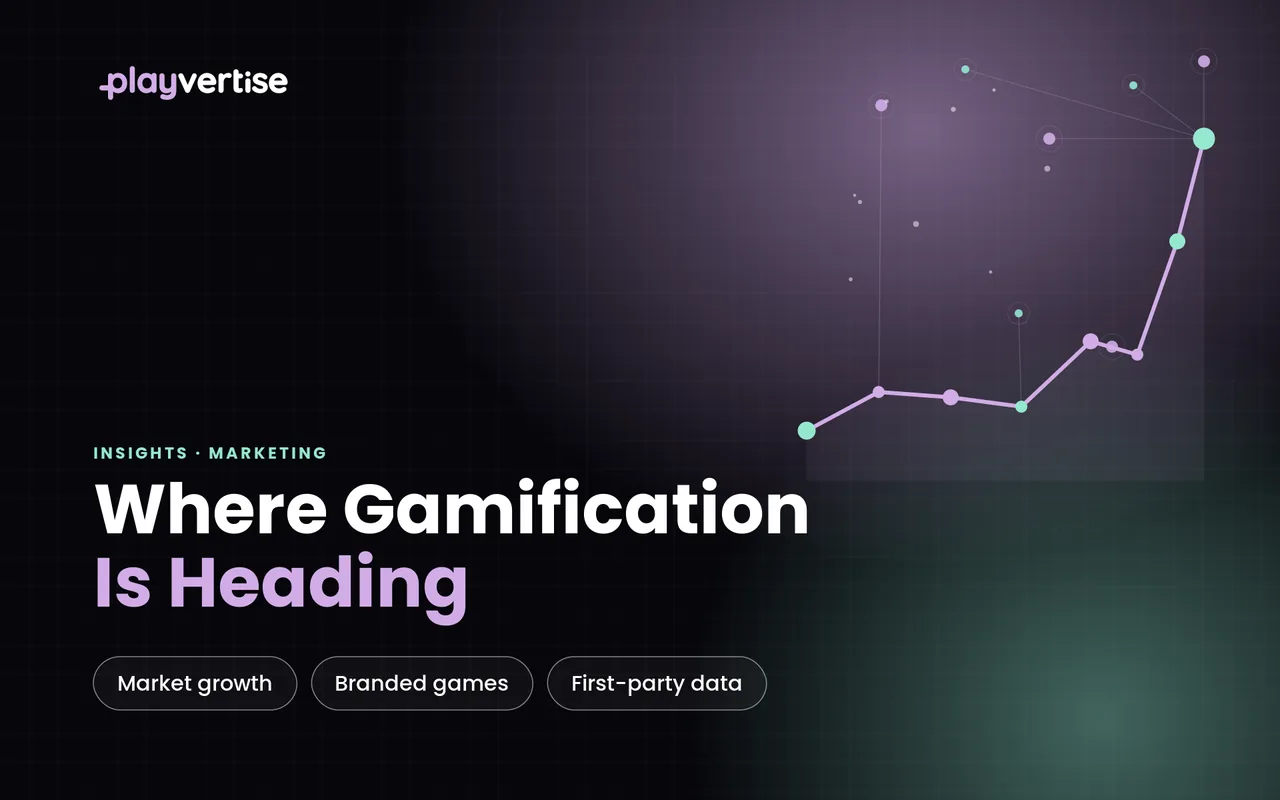
Mordor Intelligence values the total gamification market at USD 29.11 billion in 2025 and USD 112.32 billion by 2031, a CAGR of 25.24 percent (Mordor Intelligence, 2026). A single forecast is easy to discount, so it helps that a second, independent house lands in the same territory: Fortune Business Insights projects USD 308.85 billion by 2034 at a CAGR of 26.64 percent (Fortune Business Insights, 2026). The absolute numbers move with the forecast window; the shape is identical, mid-twenties growth sustained for years. That points to a structural shift, not a passing spike.
The marketing slice, worked out
Marketing and sales is one of the largest applications, at 25.24 percent of 2025 revenue (Mordor Intelligence, 2026), so roughly a quarter of a fast-growing market sits in marketing. Fortune Business Insights points to the same spot, listing brands' appetite for gamified marketing and sales, used to build loyalty and lift results, among the category's core drivers (Fortune Business Insights, 2026).
That slice spans a lot, from sales leaderboards and CRM nudges to loyalty programs and the activations people actually play. Gamification stretches across all of it, from public campaigns and event or retail activations to internal goals like teams and training, each built for its own audience. And a branded game is one of the fastest-growing formats in the slice, because it benefits from two shifts at once, how people engage with advertising, and how brands now gather their own data.
Why it works, and why that is more than a hunch
A static ad earns a glance; something people play earns time and a decision. And that is now backed rather than asserted: a 2025 peer-reviewed study using structural equation modelling found gamification to be a strong, statistically significant driver of customer engagement, with that engagement feeding higher brand loyalty and, ultimately, greater purchase intent (Punwatkar & Verghese, 2025). Participation drives engagement, engagement builds loyalty, loyalty moves intent.
With playvertise the brand does not sit next to the game as a logo in the corner, it is the game, from the colors and sprites to the prize logic and the lead fields. Whoever plays moves through a world that looks and behaves like your brand, which turns a contact into an interaction rather than an impression.
Most of the risk sits in the design
Mordor names its own brake on the category: programs that are built badly tend to lose money rather than make it (Mordor Intelligence, 2026). Gamification does not pay off simply because something has been gamified; it pays off when the game is genuinely good, clear to grasp in seconds and satisfying to play. A weak, generic build is where the fatigue and the wasted budget come from. That is the bar playvertise is built to clear: every game is designed to be easy to pick up and actually enjoyable, carrying the brand throughout, so the activation earns attention instead of eroding it, and that risk is handled by design rather than left to chance.
The quieter driver: first-party data
As third-party tracking keeps shrinking, and in a GDPR-first market like the DACH region that pressure arrives earlier, brands need formats that generate their own data. The gap is measurable: shoppers put on average 54 percent more spend behind brands that tailor the experience, while just 16 percent of brands feel they hold the data needed to deliver it (Twilio, 2024). A branded game closes part of that gap, because the contacts it collects are opt-in and first-party, handed over by people who chose to take part. Engagement and data become one activation.
Bringing it together
That is where playvertise comes in, and the way in matches the speed the market data points to. In the GameHub you first pick the mode, which sets where the game will run, on a screen and digital signage or on mobile and web, then choose a game from the library and brand it end to end. Setup is quick, and from there every activation is just configuration, live in a short time with no app, no extra hardware and no code. Each play is measured from the first tap, with plays and opt-in contacts in the dashboard and exportable as a CSV. Build it once, and the game is yours for the license term to reuse across the channels your mode covers, and to adapt to the season, so one campaign becomes a reusable asset rather than a one-off spend.
If gamification is on the plan for the year, the branded game is where the market's momentum turns into attention and first-party data at the same time. Let's look at what that could be for your brand. Talk to us at playvertise.io.
Sources
- Fortune Business Insights. (2026). Gamification market size, share & industry analysis, 2026–2034. fortunebusinessinsights.com
- Mordor Intelligence. (2026). Gamification market size & share analysis: Growth trends and forecast (2026 to 2031). mordorintelligence.com
- Punwatkar, S., & Verghese, M. (2025). Investigating the impact of gamification on customer engagement, brand loyalty and purchase intent in marketing. Journal of Applied Research and Technology, 23(1), 94–102. doi.org
- Twilio. (2024). State of customer engagement report 2024. twilio.com
Try the idea as a campaign?
We translate the idea from this article into a concrete game setup, tailored to your channel and budget.
Free and non-binding