
DOOH Keeps Growing: Where Is the Innovation in What Runs on the Screens?
Digital out-of-home is one of the few media channels that has grown double digits for years in a row. The infrastructure behind it has changed dramatically: programmatic buying, audience data, dynamic triggers. What people actually see on the screens has changed far less. That gap is where the next step for the channel lies.
The numbers point in one direction
In Germany, DOOH gross advertising revenue rose by around 26 percent in 2025 to roughly EUR 1.7 billion, and digital now accounts for 48 percent of the out-of-home segment (Nielsen Ad Trend 2025, via invidis, 2026). Globally, DOOH spending grew 12 percent to USD 27.47 billion in 2025, the fourth consecutive year of double-digit growth, while traditional OOH grew 4.1 percent (PQ Media, 2026). In the US the picture is the same: total OOH revenue rose 3.6 percent to USD 9.46 billion, with digital growing 10.5 percent and reaching a 36.3 percent share (OAAA, via MediaPost, 2026).
Different markets, different sources, one pattern. Budgets are moving from paper to pixels, and the move is not slowing down.
The innovation so far sits in the buying
Most of what has made DOOH attractive in recent years happens before a spot goes live. Campaigns are booked programmatically, by time slot and by audience. Creatives switch with the weather, the time of day or the score of a match. Reach is measured and reported more precisely than in the poster era.
All of that makes it easier to place a message. It does little for the message itself. On a large share of screens, the content is still a loop of short spots built to be understood in a glance. The screen can do far more than it is asked to.
The next step is the contact itself
The question that remains open is what happens between the screen and the person in front of it. Today that relationship ends with being seen. The person cannot respond, and the brand learns nothing about them beyond a modelled audience estimate.
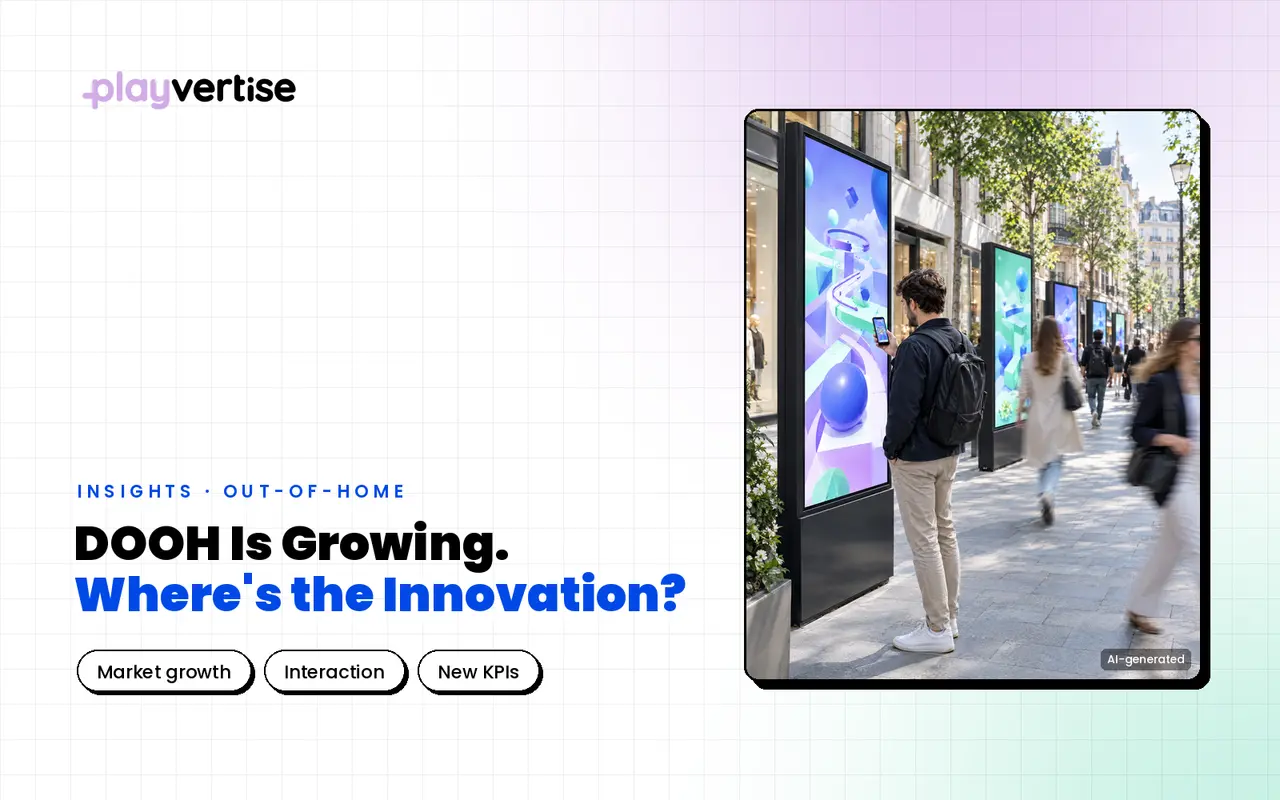
Interaction closes that gap. When the screen invites people to play, scanning a QR code is no longer the end of a call to action, it is the start of an experience. Participants enter their data and opt-ins on their phone, start the game and steer what happens on the big screen. A contact becomes a few minutes of attention, and a modelled audience becomes a list of people who opted in. We describe the mechanics in detail in our article on interactive DOOH.
Why this matters for brands and screen owners
For brands, interaction adds the KPIs that DOOH has always struggled to deliver: plays, dwell time, leads and opt-ins. That is a different conversation in the budget meeting than impressions alone.
For screen owners and networks, it adds a product. A location that can host a game, and report participation instead of only footfall, offers something a standard slot does not. In a market where more and more inventory looks alike, that is a reason to choose one network over another.
Built for the existing infrastructure
Interaction does not require new hardware. A playvertise game runs as a web application inside the screen CMS that is already in place, Grassfish, Yodeck or any web-based system, and sits in the playlist like any other content. In the GameHub you first choose the mode, Screen and Digital Signage, then a game from the game library, and brand it completely, from logo and colors to sprites, prize logic and lead fields. Setup is quick, and every further location is configuration.
The game is licensed monthly. During the license term the build is yours and can run as often as you want across the channels the Screen mode covers, adapted to the season if you like.
Bottom line
DOOH has solved where and when a message appears. The open question is what people can do with it. The growth figures show the channel has the budgets. Interaction is how it earns attention and data to match.
Advertising you play. Planning DOOH for next year and curious what an interactive slot could look like? Let's talk at playvertise.io.
Sources
- invidis. (2026, January). Germany: DOOH market surges over 25 percent in 2025 (based on Nielsen Ad Trend 2025). invidis.com
- MediaPost. (2026). OAAA reports OOH advertising rose 3.6% in 2025. mediapost.com
- PQ Media. (2026). Global digital out-of-home media forecast 2026–2030 (reported by invidis). invidis.com
Want to try this idea as a campaign?
We translate the idea from this article into a concrete game setup, tailored to your channel and budget.
Free, no strings attached