
Your Game Goes Where Your Campaign Goes: Screen Mode, Mobile Mode, and What Each Does Best
Our branded games run in one of two modes. Screen mode puts the game on a large surface, with the phone as the controller. Mobile mode puts the whole game on the phone, opened from a link or a QR code.
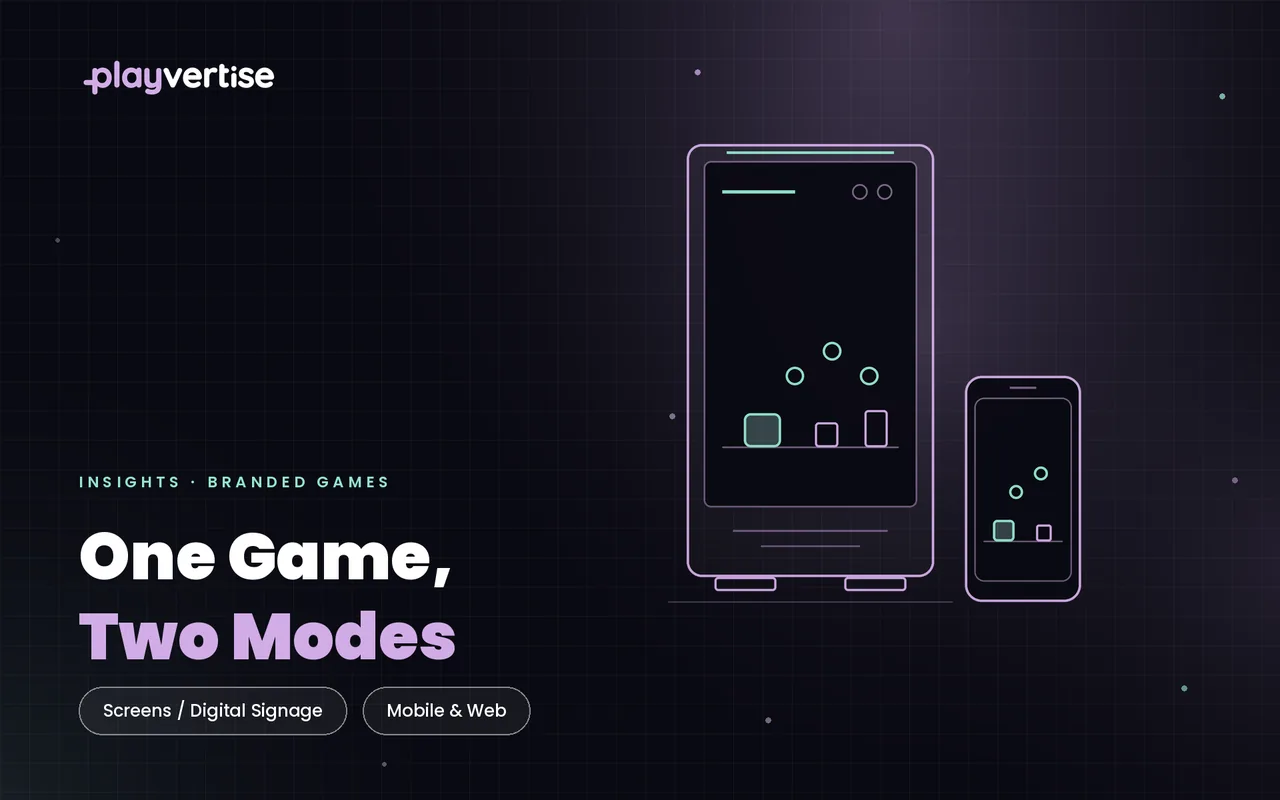
Our branded games run in one of two modes. Screen mode puts the game on a large surface, a booth screen or a digital signage face, with the phone as the controller. Mobile mode puts the whole game on the phone, opened from a link or a QR code.
Which one you pick follows from where your campaign happens. A trade fair, a store window or a sponsored stage calls for screen mode, because the play becomes visible to everyone standing around it. A social campaign, a packaging promotion or a newsletter activation calls for mobile mode, because the game travels with the link instead of the location. Many campaigns run in a single mode, some use both.
What they share is the device in your audience's hand. In Germany the smartphone is the most used gaming platform with 22.9 million players, ahead of console at 20.5 million and PC at 13.1 million (game, 2025). Whether the phone steers a game on a wall or runs it in the browser, people already know what to do with it.
Where each mode runs
Screen mode covers the places you hold physically: the booth, the store window, the signage network, the stage at an event. Mobile mode covers the ones that travel with your media: a social post, a story, social ads, a landing page, a QR code at the point of sale, a code on the packaging. Anywhere a link fits, the game fits.
The entry point is whatever suits the placement: a link in a post, a story or an ad, or a QR code where there is nothing to tap. In either case the game itself opens in the browser, in a new tab rather than inside the feed, with no app and no store detour in between. At the shelf edge, on the label or in the parcel, it reaches someone who already has your product in their hand, and what the game asks for at that moment, an email, an opt in, a postcode, is data you own rather than borrow.
In practice: both modes in one campaign
This summer Stibitzer, the ready to drink brand from Brau Union, ran what was billed as Austria's first crossmedia gamification campaign: FoxQuest, a jump and run through the Vienna skyline, on 57 DOOH screens in the Azerion network. At four locations in Vienna the game was playable on the screen itself, steered from the phone. On all other screens a creative ran that linked to the mobile version, which was played on the phone. One build, both modes, and a play in front of every screen in the campaign. Brau Union commissioned it, Azerion Austria brought the network, Dentsu Austria the media, and we built the game.
One build, one dashboard
In the GameHub you pick the mode, choose a game from the library and brand it end to end: logo, colors, sprites, prize pool and probabilities, and the lead fields you need. The build stays yours for the license term and can be reused across the channels your mode covers, as often as you like. If the next campaign calls for the other mode, it is added to the build you have, with branding, prize logic and lead fields untouched.
Whichever channel a play comes from, it lands in the same place. Plays and new opt-in contacts are visible in real time and exportable as a CSV, whether that is one campaign across several channels or several campaigns over the year. You do not have to assemble the numbers, they are simply there, per activation and side by side.
Takeaway
Take the next few months in your plan and sort them. A fair, a store window, a sponsored stage: screen mode. A launch through your own channels, a promotion on the packaging, a push in the newsletter: mobile mode. Most plans have both kinds on the list, which is exactly why it is worth having one game that covers them, with one prize logic to adjust and one dashboard to look at.
Got a campaign in mind? Let us know and we will map it out with you, from the mode to the game to the prize logic, at playvertise.io.
Sources
- Internet World Austria. (2026). Azerion und Stibitzer bringen DOOH-Premiere: Österreichs erste crossmediale Gamification-Kampagne. internetworld.at
- game – Verband der deutschen Games-Branche. (2025). Meistgenutzte Spieleplattformen in Deutschland: Konsole und Smartphone gewinnen Spielende hinzu (data: YouGov). game.de
Try the idea as a campaign?
We translate the idea from this article into a concrete game setup, tailored to your channel and budget.
Free and non-binding