
Interaction at the Trade Show Booth: Why Visitors Stop Where They Can Take Part
A trade fair day is short and crowded. Visitors hold an average of 13.1 business conversations per day at a fair (AUMA, 2024), and every stand in the hall is competing for a place on that list. Most stands try to win it with what they show: a bigger wall, a brighter screen, a better product shot. The stands that fill up tend to win it with what visitors can do.
Seeing is not the reason people come
Trade fairs remain the place where people want to get their hands on things. In Freeman's 2025 trends report, 96 percent of attendees said touching or testing a product makes them more confident advocating for it, and nearly one in four said their most important event of the year offered no hands-on exposure at all (Freeman, 2025). The appetite for interaction is there. Many stands do not serve it.
This is also why the fair itself is not being replaced. 61 percent of the business contacts made at fairs could not have taken place digitally in the same quality (AUMA, 2024), and 97.5 percent of exhibiting companies consider trade fairs indispensable (AUMA, 2026). What a stand offers on site is the part no video call can deliver.
The problem with the aisle
Between the aisle and the conversation there is a threshold. Visitors slow down, glance at the stand, and decide in a second whether stepping in is worth it. Many do not, because stepping in usually means being pitched.
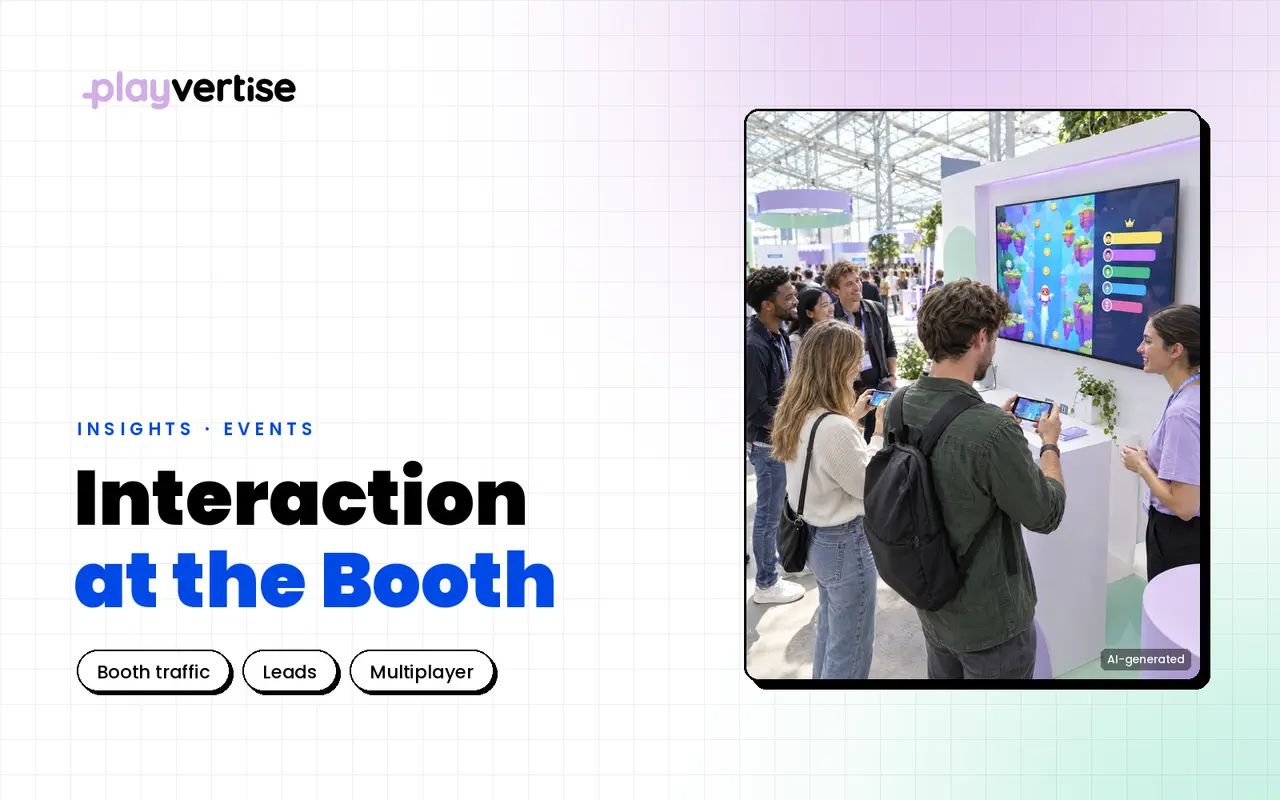
Interaction lowers that threshold. A game on the stand screen gives people a reason to stop that is not a sales talk. Someone plays, a few others watch, the leaderboard fills up, and the stand looks busy, which draws in the next visitors. For the team, a player is a far easier first conversation than a passer-by: you already have a topic, and the person has already decided to stay.
Interaction that produces contacts
The difference between a gimmick and a lead tool is the order of play. With playvertise it is always the same: visitors scan the QR code on the screen, enter the data you defined and confirm their opt-ins, then the game starts on the big screen with their phone as the controller. The contact is captured before the first move, not on a scanner at the end of a conversation that may never happen.
Afterwards plays and new contacts appear in the dashboard in real time and can be exported as a CSV. The sales team goes home with a list of opt-in contacts, not a stack of business cards. We have written separately about which KPIs gamification can deliver.
What a game on the stand needs
A few things decide whether interaction works in a busy hall:
- Understood in seconds: the mechanic has to be clear before someone has fully stopped walking.
- Short rounds: a round that fits into a pause, so the line keeps moving.
- A visible prize logic: what can be won, and how likely, set in the prize pool.
- The brand in every detail: logo, colors and sprites, so the game is clearly yours from across the aisle.
- No barriers: no app, no download, no registration beyond the lead form.
In the GameHub you choose the Screen mode for the stand display, pick a game from the game library and brand it end to end. If several people should play at once, multiplayer turns waiting visitors into opponents.
One build for the whole fair season
Most companies exhibit more than once a year. Because the game is licensed monthly, the build belongs to you during the license term and runs as often as you like across the channels your mode covers: the next fair, the showroom, the store. Between dates you change the prize pool or adapt it to the season, without a new build. Our article on gamification at trade fairs looks at more use cases.
Bottom line
Visitors come to trade fairs to try things, and they stop where they can take part. A game on the stand gives them a reason to stay that is not a pitch, gives the team an easy opening, and captures contacts before the first move.
Advertising you play. Is your next fair already in the calendar? Let's find out what your stand could look like as a game, at playvertise.io.
Sources
- AUMA – Association of the German Trade Fair Industry. (2024). Mehrwert von Messebesuchen [The added value of trade fair visits]. auma.de
- AUMA – Association of the German Trade Fair Industry. (2026). Messe Insights: Aussteller-Ausblick 2026/2027 [Exhibitor outlook 2026/2027]. auma.de
- Freeman. (2025). Unpacking XLNC: The future of commerce for trade shows and conferences (Freeman Trends Report). markets.financialcontent.com
Want to try this idea as a campaign?
We translate the idea from this article into a concrete game setup, tailored to your channel and budget.
Free, no strings attached